Pictograms of a man and a woman on a white wall.

Don't be afraid of toilet seats!

Hygiene myths about public toilets

Either at rest stops, airports, or train stations, public restrooms aren't exactly appealing. Many people particularly find toilet seats a great source of disgust.They fear that if they sit on it, they’ll immediately catch a disease because of all the germs and bacteria. But this concern is unfounded. We explain why it’s safe to sit down on public toilets - and where the real hygiene dangers lurk.
Approaches to hygiene have changed greatly over the course of humanity. For centuries, very different forms of cleanliness were practiced, depending on religion, nation, and culture. Progressive discoveries were always met with resistance; there were intrigues and important knowledge was lost again. The use of disinfectants is also relatively new, with a history of only about 150 years. What did people consider “clean” in the past? How did they wash themselves and protect themselves from viruses and bacteria?

When going to the toilet causes disgust

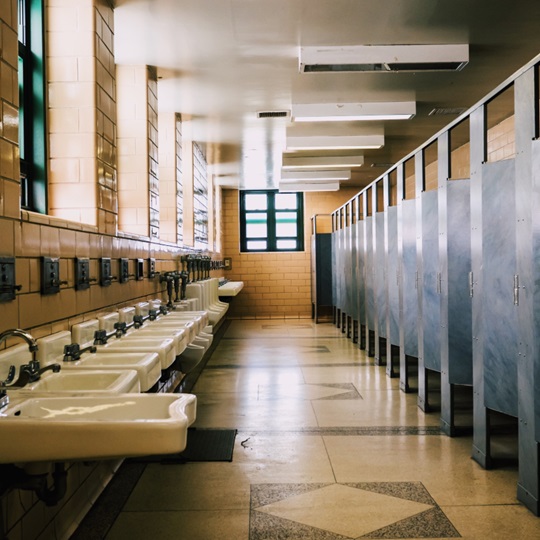
A public restroom with a row of sinks on the left and cubicles on the right.

Everyone has experienced this situation at some point: You're out and about when you suddenly need to go to the bathroom urgently. Although you're first glad to have found a toilet at all, you then start wondering who sat on the toilet seat right before you. Or you wonder how often the place is cleaned. You then cover the seat with toilet paper to ensure that not a millimetre of porcelain remains free. Better safe than sorry. Or you squat down so that you don't have to touch the seat even for a second.

This feeling of disgust when using a public restroom is widespread. According to a representative Forsa survey from Germany, a full 87 percent of respondents find them particularly unpleasant to use [1].

This puts public toilets at the top of the disgust scale, ahead of bus or train grab bars, escalator handrails, or shopping cart handles. The main reason for this discomfort is a fear of germs. As another study by the market research institute net-request shows, 72 percent of women and 63 percent of men are afraid of coming into contact with dangerous pathogens in public toilets [2].

Pathogens are not transmitted via skin contact

Admittedly, sanitary conditions are not inviting in many public restrooms. From paper towels on the floor to unpleasant odours to "leftovers" from the previous user, the hygienic conditions can vary greatly. Of course, if there is a lot of contamination, it is better to go somewhere else if possible. However, if everything appears visually clean, there is actually no danger from pathogens when sitting down on the toilet seat.

The reason: bacteria and germs enter our bodies through the mucous membranes or damaged skin barriers, such as small wounds, not through mere skin contact. So, anyone who sits on the toilet normally and has no sores is safe from pathogens. If the skin barrier is intact, it forms a natural protective layer that microorganisms cannot get past [3,4]. In addition, toilet seats are often less germ-laden than many people think. On average, far more pathogens are found on conventional everyday objects such as smartphones or kitchen sponges than on toilet surfaces [5,6].
A dirty toilet with its lid up, surrounded by graffiti on the walls and the toilet paper holder.

Disinfection instead of toilet paper

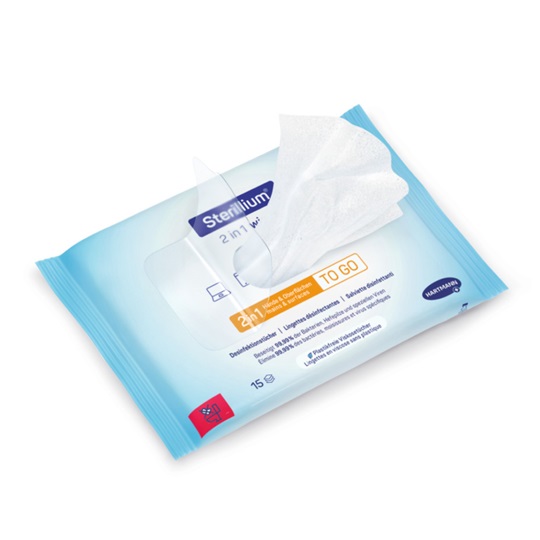
However, if you are still disgusted by sitting on the toilet seat, you can easily disinfect it beforehand. Practical surface disinfectant wipes, such as Sterillium® surface wipes* or Sterillium® 2in1 wipes*, are ideal for this purpose. They are a great alternative to lining the toilet seat with several layers of paper as it saves resources and thus protects the environment.

Using toilet paper to prevent contact with the toilet seat also has another downside. Germs that swirl around in the toilet cubicle air, for example during the flushing process, can collect in the toilet paper. Thus, if you generously line the toilet seat with toilet paper and then touch this contaminated material with your hands, this increases the risk of infection if you subsequently touch your face [7,8]. For a norovirus infection, for example, which is particularly rampant in winter, as few as 100 virus particles are sufficient to trigger an infection. Up to ten million noroviruses can be found in every gram of stool from infected patients [9]. Therefore, only use toilet paper when you really need it.
A pack of Sterillium® 2in1 disinfectant wipes.

The faucet - the real danger in public toilets

Since hands are the main carriers of germs, the real source of danger in public toilets is actually the water faucet. After all, people touch it after going to the toilet before washing their hands, which means that germs can collect there. If you wash your hands, touch the faucet to turn it off - and then touch your face, you significantly increase your risk of infection. It is therefore better to disinfect toilet taps before use. Or to disinfect your hands after washing them. A disinfectant such as Sterillium® is suitable for this purpose.

It is important, however, to dry your hands before disinfecting them. But be careful with air dryers. Various studies have warned for years that such devices can cause pathogens like bacteria to swirl through the air [10,11,12]. It is therefore more hygienic to simply dry your hands in the air or use paper towels if available.

The door handle as a final hurdle

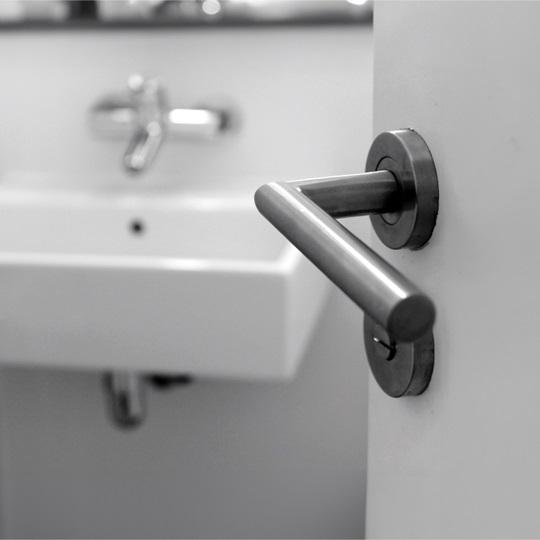
Black-and-white close-up of a door handle with a sink in the background.
Once the hands have been washed, dried, and disinfected after using the toilet, one last hurdle remains - the doorknob. To avoid immediately re-contaminating your hands, it is better to touch the knob with a paper towel. Alternatively, you can open the door with your elbow - even if it looks a little strange.

If you follow these measures, you have nothing to fear the next time you use a public toilet. You no longer need to studiously cover toilet seats or squat while using them. Sitting instead of squatting also leads to cleaner toilets in general because so many people miss the "mark" when they hover over the toilet. So spread the word! The less people fear public toilet seats and use them normally, the more pleasant it is for everyone in the future.

Sources:

[1]kkh.de/ Öffentliche Toiletten auf Ekel-Skala ganz oben https://www.kkh.de/presse/pressemeldungen/oeffentliche-toiletten-auf-ekel-skala-ganz-oben

[2]sanitärjournal.de/ Ekelfaktor öffentliches WC https://www.sanitaerjournal.de/ekelfaktor-oeffentliches-wc_12672

[3]sos.de/ Wo Krankheitserreger auf öffentlichen Toiletten lauern https://www.sos.de/wo-krankheitserreger-auf-oeffentlichen-toiletten-lauern#:~:text=Auf%20%C3%B6ffentlichen%20Toiletten%20k%C3%B6nnen%20unterschiedlichste,vermutet%2C%20vom%20Toilettensitz%20selbst%20aus

[4]t-online.de/ Die Klobrille ist nicht die schlimmste Keimschleuder https://www.t-online.de/gesundheit/id_63478312/hygiene-klobrille-nicht-die-schlimmste-keimschleuder.html

[5]focus.de/ Die Wahrheit über öffentliche Toiletten https://www.focus.de/gesundheit/videos/pilze-bakterien-und-keime-die-wahrheit-ueber-oeffentliche-toiletten_id_3943197.html

[6]sueddeutsche.de/ Wie Japan Smartphones keimfrei bekommen will https://www.sueddeutsche.de/panorama/japan-wisch-und-weg-1.3309777

[7]merkur.de/ Aus diesem Grund sollten Sie niemals Klopapier auf die WC-Brille legen https://www.merkur.de/leben/gesundheit/diesem-grund-sollten-niemals-klopapier-wc-brille-legen-zr-10359930.html

[8]focus.de/ Toiletten-Fehler: Deshalb sollten Sie nie Klopapier auf die Klobrille legen https://praxistipps.focus.de/ekliger-toiletten-fehler-deshalb-sollten-sie-nie-klopapier-auf-die-klobrille-legen_94974

[9] Hamburger Abendblatt, 27.11.2017, S.12 / In Bussen und Bahnen lauern die meisten Keime

[10]t-online.de/ Sind Händetrockner gefährlich für unsere Gesundheit? https://www.t-online.de/gesundheit/gesund-leben/id_84642080/forscher-haendetrockner-bedrohen-unsere-gesundheit.html

[11]morgenpost.de/ Warum Sie Händetrockner in Waschräumen meiden sollten https://www.morgenpost.de/vermischtes/article235922801/haende-waschen-trockner-meiden-bakterien-viren-aerosole.html

[12]derstandard.de/ Studie: Händetrockner sind Bakterienschleudern https://www.derstandard.de/story/2000092463255/studie-haendetrockner-sind-bakterienschleudern


Biocide mandatory texts*:
Art. 72 pursuant to EU/528/2012: Use disinfectants safely.
Always read the label and product information before use.

*Please amend in accordance with local requirements (e. g. law of advertising, product status, CLP labelling).

„HWG“-Pflichttexte, alternativ auch im Website-Footer.