
Spotlight Series
From Management to Healing with Wound Balance

Read the interview with Dr. Laura Swoboda about her award winning approach "Wound Balance".
Learn more


In this issue, we feature Dr. Alessandro Falchetti, thoracic and cardiovascular surgeon at the Centre Hospitalier de la Côte Basque in Bayonne, France. Dr. Falchetti has extensive experience in both minimally invasive endovascular arterial surgery for aneurysmal and occlusive lesions of the aorta and peripheral arteries, as well as traditional open surgery. He is part of the multi-disciplinary team managing complex wounds and therapeutic approaches intended for advanced wound healing.
Through his case insights and clinical reasoning, Dr. Falchetti illustrates how the right therapeutic choices can significantly influence outcomes for patients dealing with complex wounds.
Through this exchange, we hope to inspire other healthcare professionals by illustrating how innovative approaches in wound healing can transform the management of patients with wounds.
In your daily practice in thoracic and cardiovascular surgery, what are the main challenges related to managing post operative wounds?
I would say the main challenges are predominantly associated with complex wounds rather than exclusively post operative wounds. These patients frequently present significant fragility, malnutrition, and challenging social circumstances. Additionally, local factors further complicate wound management. One of our practice particularities is that we manage numerous stage 4 arteriopathies, and therefore, patients with critical wounds. In patients with vascular diseases, wounds commonly exhibit infection, substantial tissue loss, and bone exposure, making healing difficult.
Could you share some concrete examples?
Patients with heel pressure ulcers often pose significant challenges. Why? Because this is an area difficult to heal and that immobilises patients. It is harder to offer a simple local surgical solution, since it is not like a toe that can be amputated. These cases represent a risk of major amputation. We have treated patients with bilateral heel pressure ulcers, where the problem is essentially doubled. Recently, we had a patient, coming out of intensive care after a cardiac procedure, with bilateral heel pressure ulcers and bilateral arteriopathy, which made wound management particularly challenging.
In such a case, how do you anticipate the risks of healing complications?
Firstly, our intervention focuses on optimising the patient's overall condition. The management must be quick. We require a multidisciplinary approach to address risk factors, malnutrition, and patient mobility. Subsequently, attention shifts to local factors, specifically the wound. Following revascularization, our efforts are directed at maintaining an appropriate moist wound environment and reduce bacterial burden – it is crucial to modify the wound’s biochemical environment to shift it from a chronic to an acute wound.
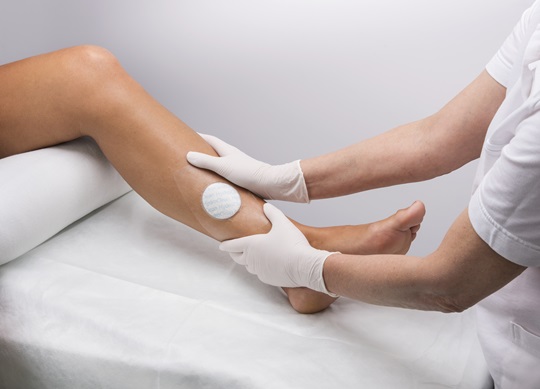

It is crucial to modify the wound’s biochemical environment to shift it from a chronic to an acute wound.
In summary, you anticipate healing complications on two levels: overall for the patient and locally for the wound. What criteria guide your therapeutic choices?
There are mainly clinical and biological criteria. Once patients in our department have been revascularised, we follow them closely, checking wound evolution in terms of clinical criteria: percentage of fibrin, granulation, necrosis – and biological criteria, by monitoring the infection status. According to these, we adapt our dressing protocols to heal the wound as quickly as possible.
Can you tell us about a particular wound healing case where you had to adapt your clinical approach to optimise the treatment?
I recently treated a complicated geriatric patient who was hospitalised for an aortic valvular replacement by TAVI for which he spent a long time in intensive care. He developed pressure ulcers on both heels due to arteriopathy. After intensive care, the patient was in a state of malnutrition and immobilised, all factors contributing to poor wound healing.
Which therapeutic solutions did you consider for this patient?
Our first step was to promptly plan revascularisation for both heels. Secondly, we adapted the local clinical protocol. Our goal was to gently debride the wound, which was necrotised when we started the treatment and therefore, change the wound status to initiate the granulation phase, without being too aggressive, nor risking infection or tissue loss. To achieve this, we used
HydroClean® Advance which allowed a gentle debridement, helped reduce infection risk by sequestering the bacteria, and created a more favourable biochemical environment by capturing inhibiting proteinases.
What led you to choose HydroClean® Advance for this case?
Firstly, this is an unique dressing that we use frequently for debridement; it rinses the wound while capturing excess matrix metallo-proteinases and bacteria. It supports us in addressing our concerns, such as possible infection after debridement, and helps us change the biochemical environment of the wound. This is a Hydro Responsive Wound Dressing (HRWD) which is unique in its kind, with Rinsing-Absorption- Mechanism, and our dressing of choice in this case.
Our goal was to gently debride the wound (…) and change the wound status to start granulation phase.
Geriatric male patient with medical history of Obliterating Arteriopathy (peripheral artery disease – PAD), who was hospitalised for an aortic valvular replacement via Transcatheter Aortic Valve Implantation (TAVI) with a prolonged stay in intensive care. Patient developed pressure ulcers on both heels due to arteriopathy, was immobilised and presented signs of malnutrition.
Proactive factors addressed


HydroClean® Advance allowed a gentle debridement, helped reduce infection risk by sequestering the bacteria, and created a more favourable biochemical environment. This is a HRWD which is unique in its kind, with a Rinsing-Absorption-Mechanism.
In your daily practice, would you consider HydroClean® Advance an easy-to-use dressing?
It is indeed an easy-to-use dressing: it can be adapted to different parts of the body without problems. Generally, there is an excellent acceptance from the patients’ perspective. Overall, it checks all the boxes for “simple” use. It is a product that we are using on a daily basis for different indications – from acute to chronic wounds.
Would you say that your peers also share this point of view?
Absolutely! HydroClean® Advance is well accepted by the healthcare teams, as it brings good results. I believe that all professionals have the objective of rapid wound healing; therefore, if we have “weapons” that lead us to healing in less time and with less constraints for the patients, these are well accepted by everyone.
To finalise, what could, in your opinion, encourage other practitioners to adopt this solution in their practice?
First, it's important to understand the “philosophy of wound” and use a dressing, such as HydroClean® Advance, that meets the needs of complex wounds. And then, I would say you have to gain experience by working with it. You can be accompanied by HARTMANN representatives if you need initial support. With the experience, you will use this dressing in your daily practice in a rather natural way.

