

BSI: the facts to know
The consequences can be deadly: BSI is associated with mortality rates up to 46% after 1 year6. Additionally, secondary manifestations of BSI can develop, such as cardiac valve infection (endocarditis) or bone infection (osteomyelitis).
Blood infections lead to longer hospital stays, prolonged antimicrobial therapy for patients and skyrocketing costs for hospitals. Costs associated with BSI reach up to 4 billion euros a year in Europe4,7,8.
BSI: what goes wrong?
An asepsis breach commonly occurs during these key points: at catheter insertion, when changing dressings, or when handling the line. Of course, major factors contributing to blood infection are poor hand hygiene and a lack of product sterilization. Medical professionals are trained and fully aware of the measures to prevent infection. However, circumstances work against them.
Today, hospitals and medical professionals feel the stress of high numbers of patients coupled with staff shortages. There is often less time for patients and double checking each step in a procedure, let alone finding time to optimize protocols.
A high turnover of trained clinicians also means staff are not all trained to the same standard operating procedures, which leads to inconsistencies in handling.
Finally, juggling products and devices for a blood transfusion can open too many doors to infection. Too much time is spent gathering supplies, or individual components are not properly disinfected.
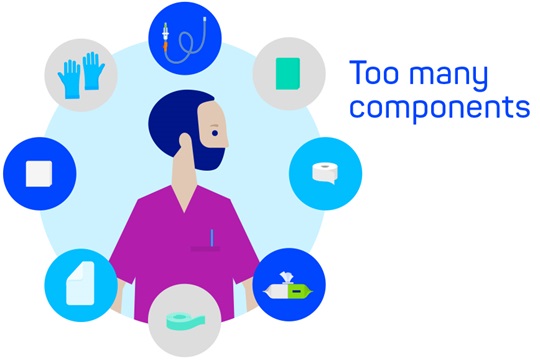

There are two aspects to reducing infection. First, training of medical staff; and second, the availability of more smartly designed, sterile medical sets, which have proven to be clinically effective and safe.
Let’s reduce rates of BSI
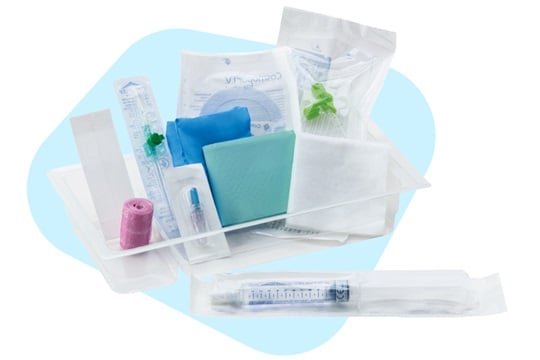
The good news is that there are scientifically established procedures proven to reduce BSI rates by up to 70%9. Among these, the usage of a pre-packed kit is highlighted by the WHO1.
Medical care centers and hospitals need to support outcome-oriented solutions that combine an action plan of best practices with the use of sterilized infusion sets in a product bundle.

Sources:
1. Guidelines for the prevention of bloodstream infections and other infections associated with the use of intravascular catheters. Part I: peripheral catheters. Geneva: World Health Organization; 2024. Licence: CC BY-NC-SA 3.0 IGO.
2. Global Market Report Suite for Vascular Access Devices and Accessories, iData Research, 2020.
3. European Center for Disease Prevention and Control, Healthcare-associated infections – a threat to patient safety in Europe, ECDC, 2018.
4. Suetens et al. Prevalence of healthcare-associated infections, estimated incidence and composite antimicrobial resistance index in acute care hospitals and long-term care facilities: results
from two European point prevalence surveys, 2016 to 2017. Euro Surveill. 2018.
5. European Centre for Disease Prevention and Control: Annual Epidemiological Report on Communicable Diseases in Europe 2008. Stockholm, European Centre for Disease Prevention and Control, 2008.
6. One-year mortality and years of potential life lost following bloodstream infection among adults: A nation-wide population based study Schechner, Vered et al. The Lancet Regional Health – Europe, Volume 23, 100511
7. European Center for Disease Prevention and Control, Healthcare-associated infections – a threat to patient safety in Europe, ECDC, 2018.
8. WHO. (May 2011). Report on the burden of endemic health care -associated infection worldwide [Report]. Retrieved from http://www.who.int/gpsc/country_work/burden_hcai/en/.
9. Zingg et al. (2014) Hospital-Wide Multidisciplinary, Multimodal Intervention Programme to Reduce Central Venous Catheter-Associated Bloodstream Infection. PLoS ONE 9(4): e93898.
10. Fenik et al. (2013) Prepackaged central line kits reduce procedural mistakes during central line insertion: a randomized controlled prospective trial. BMC Medical Education 13:60.