

MediSet®: safer and more efficient


A holistic approach
Healthcare-associated infections are currently one of the greatest preventable threats, not only to patient safety, but also to working conditions for healthcare professionals and institutions’ bottom lines. There’s no single solution to prevent this.
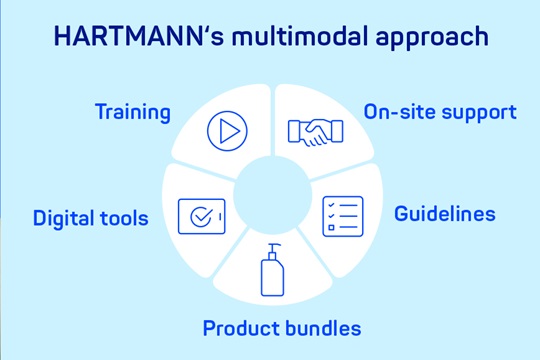
HARTMANN has devised a holistic approach to help fight HAIs that follows the multimodal approach recommended by the WHO1. A customized suite of solutions, combining products, on-site support, guidelines, digital tools, and training, that facilitates medical professionals to work more efficiently and enhances compliance to standardized practices which contributes to a reduction in HAI incidence rates.
Pre-packed care sets: addressing the needs of healthcare professionals
Many HAIs result from inadequate compliance to standard care procedures that are complex and prone to human error2. Such shortcomings are usually not due to a lack of knowledge, but implementation difficulties resulting from staff shortage, lack of time and complicated material handling.
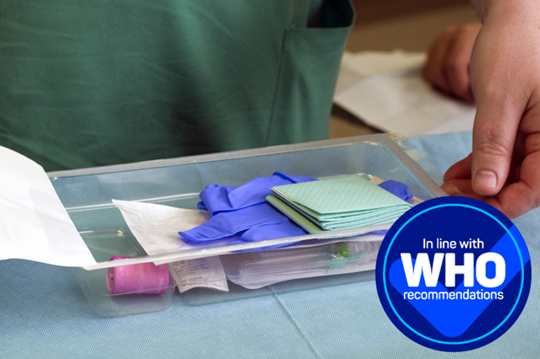
Pre-packed, sterile kits are a simple yet effective means to prevent asepsis breach while also saving time during standard care procedures. According to research, they can reduce errors by 35%3 because all the required components are ready to hand.
Infusion MediSet® sterile kits from HARTMANN
HARTMANN offers a range of MediSet®sterile kits for vascular access, including kits for peripheral venous catheters (PVC), which are identified as critical processes and causes of infections1.
HARTMANN‘s MediSet®kits range from basic to full equipment and are designed to match your habits of care. The sets cover all needs whatever ward or environment the procedure is performed in.


Disposable Tourniquet
Easy to handle: good adhesion due to micro-Velcro
Gentle: comfort due to fleece
Safe: supports hygiene process (1 tourniquet 1 patient)


They help me adhere to the standard procedures for specific care processes, because their composition has been precisely defined to fit the protocols. If the sets weren‘t available, most procedures would require additional manual work. I would also be more likely to omit essential protocol steps, which would increase the risk of infection
A solution tailored to your needs
Sources:
1. Guidelines for the prevention of bloodstream infections and other infections associated with the use of intravascular catheters. Part I: peripheral catheters. Geneva: World Health Organization; 2024. Licence: CC BY-NC-SA 3.0 IGO.
2. https://www.vdgh.de/media/file/1674.Faktenpapier_Krankenhausinfektionen_11-2010.pdf
3. Fenik et al. (2013) Prepackaged central line kits reduce procedural mistakes during central line insertion: a randomized controlled prospective trial. BMC Medical Education 13:60.
4. Sterile sets Quantitative and Qualitative study for Hartmann. Pharma-insight GmbH. October 2016
5. A. Leotsakos. Standardization in patient safety: the WHO High 5s project. International Journal for Quality in Health Care. 2014; (26)2: 109–116
6. TL. Hsiung. Job Standardization: Helping Adaptation and Retention of Newly Graduated Nurses. The Journal of Human Resource and Adult Learning. 06/2009; (5)1: 155-161.
7. S. Zarzuela. (2013). Defining standardization within the healthcare industry: An in-depth analysis of standardization from the perspective of key stakeholders. Retrieved from https://www.mohawkssi.com/en/resourcesSection/resources/ResearchPaperDefiningStandardizationinHealth carerevisedOct302013Final.pdf