High Blood Pressure in Women - What You Should Know

High blood pressure is a serious condition that is also widespread among women. The tricky part: high blood pressure usually causes no noticeable symptoms. It doesn't hurt and often goes undetected for years - until ist dramatic consequences such as heart attack, stroke, or organ damage occur.1

Thanks to the gender-specific medicine, we now know that the cardiovascular system functions differently in women than in men. As a result, women often show different symptoms of cardiovascular diseases than men. In addition, the risk of high blood pressure - the main risk factor for cardiovascular diseases - increases significantly during certain stages of a women's life.

  • Women who take the pill develop high blood pressure 2 to 3 times more often than women who do not use hormonal contraceptives.2
  • During pregnancy, 5-10% of women are affected.3
  • During menopause, more than half of women suffer from high blood pressure - more frequently than men of the same age.4
  • Even in women over 70, high blood pressure occurs more frequently than in men of the same age group.5

High Blood Pressure - The "Silent" Symptom of Menopause

Menopause is a natural phase in a woman's life, during which the female body reduces the production of sex hormones. This process can take up to 10 years. Two out of three women experience noticeable symptoms during this time, such as irregular cycles, hot flashes and night sweats, sleep problems, trouble concentrating, and mood swings.6

What often goes unnoticed, however, is high blood pressure, which affects more than one in two women during menopause.4 The reason is the declining estrogen levels. Estrogen contributes to the elasticity of blood vessels - when it decreases, the vessels become stiffer, which causes blood pressure to rise.7

Precise Measurements - Even When the Heart Is Out of Rhythm

Veroval® duo control Upper Arm Blood Pressure Monitor

Veroval® duo control delivers accurate readings even in cases of arrhythmia - thanks to the innovative DUO SENSOR technology.

High Blood Pressure During Pregnancy - a Risk for Mother and Child

During pregnancy, the expectant mother's cardiovascular system works at full capacity to optimally supply both her and the unborn child. In addition to typical hormonal changes, this condition particularly affects the cardiovascular system. For example, the available blood volume increases by up to 50%, and the heart beats significantly faster.8

About 5-10% of pregnant women develop high blood pressure,3 which often goes unnoticed. In most cases, pregnancy progresses without complications. But in rare cases, a condition knon as preeclampsia can develop - a dangerous form of high blood pressure that can seriously harm both mother and child. That's why it's essential to regularly monitor blood pressure during pregnancy.
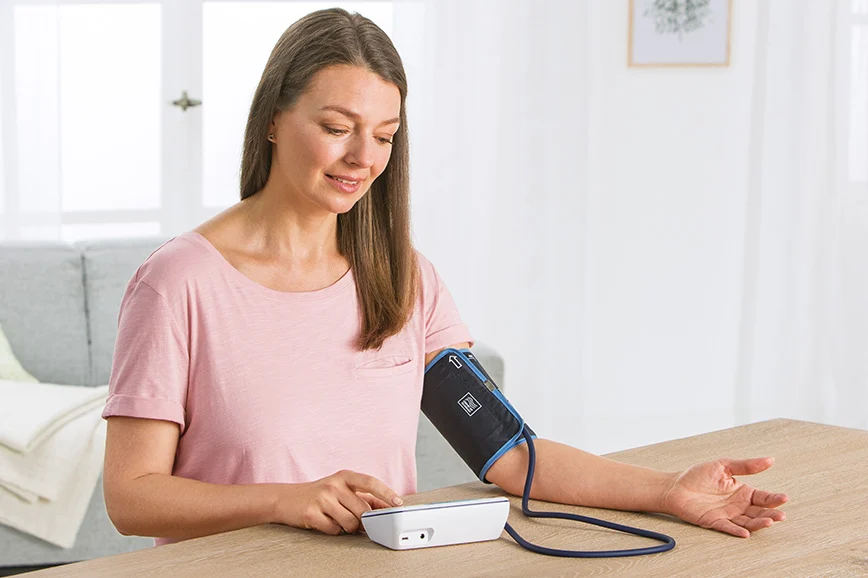
For Quick and Easy Blood Pressure Measurement on the Upper Arm

Veroval® compact + Upper Arm Blood Pressure Monitor

Veroval® compact + provides accurate and gentle measurements. Also suitable for prenatal care.

Proper Blood Pressure Monitoring - Keep an Eye on Your Readings

High blood pressure often goes unnoticed - this is why it is referred to as the "Silent Killer". The consequences of undetected high blood pressure can be severe, even life-threatening. That's why it's important to monitor your blood pressure regularly - either at the doctor's office or conveniently at home.

  • Home blood pressure monitors are available in pharmacies or online
  • Our Veroval® devices use a traffic light system to clearly categorize the values:

    Normal Range

    Elevated Blood Pressure

    Critical Value

  • Veroval® medi connect App: The Added Plus for Your Devices
    With the free Veroval® medi.connect app, you'll quickly become your own health manager. Receive precise blood pressure readings and transfer the data to your smartphone or tablet to get detailed charts of your values. Thanks to the app, there's no need to keep a traditional blood pressure log. You can analyze your readings directly, print the data quickly, or send it to your doctor via email.
  • When should you see a doctor?
    If your readings are repeatedly in the red zone, you should definitely talk to your doctor. If he also find consistenly elevated readings, he may recommend an appropriate treatment to help stabilize your blood pressure.
1 WHO Global report on hypertension: the race against a silent killer. 19 September 2023. https://www.who.int/teams/noncommunicable-diseases/hypertension-report
2 Pimenta E, Hypertension Research (2012) 35, 148 – 152; published online 1 December 2011.
3 Hutcheon JA, Lisonkova S, Joseph KS. Epidemiolo - gy of pre-eclampsia and the other hypertensive disorders of pregnancy. Best Pract Res Clin Obstet Gynaecol 2011; 25(4):39 – 403.
4 Lima et al, Hypertension in Postmenopausal Women, Curr Hyper - tens Rep. 2012 June ; 14(3): 254 – 260.
5 Oliveros L et al, Hypertension in older adults: Clin Cardiol. 2019 Dec 11; 43(2):99 –107.
6 https://www.aerzteblatt.de/archiv/183884/ Beschwerden-in-den-Wechseljahren-Nicht-nur-eineFrage-der-hormonellen-Situation
7 https://herzstiftung.de/service-und-aktuelles/presse/pressemitteilungen/herzwochen-2021-bluthochdruck-frauen
8 Cited from: Hypertension during pregnancy and breastfeeding. www.hochdruckliga.de/betroffene/bluthochdruck/bluthochdruck-in-der-schwangerschaft-undstillzeit