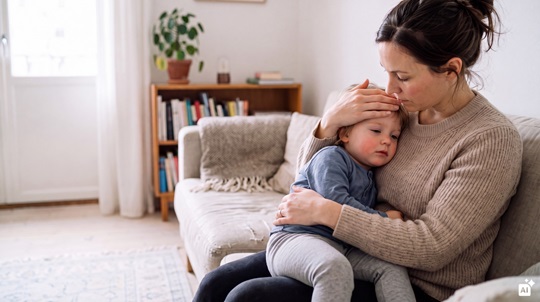
What to do when your child has a fever: caring for them and understanding the symptoms

Suddenly, the fever is there. Just moments ago, your child was running around or kicking their legs energetically. A little later, their eyes look glassy and their forehead and cheeks feel burning hot. Fever in children can leave many parents feeling uncertain – especially when a baby has a fever. Yet a rise in temperature is not, in itself, an illness, but a natural response by the body. Taking their temperature correctly, keeping an eye on how they are feeling and recognising important warning signs can help you assess the situation.

Understanding fever in children: what does their temperature tell you?

“Is fever dangerous, or is my child’s body doing exactly what it should?” Although a child with a fever often causes parents concern, fever is initially a helper rather than an enemy. The higher body temperature supports the immune system in fighting viruses and bacteria. What matters is therefore not just the thermometer reading, but above all how your child is feeling. But when is a temperature actually considered a fever? In children, a body temperature of 38.5 °C or above is considered a fever; in babies under three months, the threshold is 38.0 °C. A high fever is defined as 39.0 °C or above.1,2

Assessing fever in babies and toddlers

The younger your child, the more cautiously you should assess a fever. If a baby under three months has a rectal temperature of 38.0 °C or above, seek medical advice immediately. This also applies at lower temperatures if your baby seems unusually listless, is feeding poorly or their skin colour changes. For children aged three months and over, their general condition is the main consideration. If your child has periods of being alert despite the fever, drinks enough and shows no other unusual signs, you can generally monitor them at home initially.1,2 Their body temperature will often have returned to normal by the next day.

Taking your child’s temperature: knowing where and how

Placing a hand on their child’s forehead to feel for warmth: many parents do this instinctively when they suspect a fever. A thermometer then provides a reliable answer – although where you take the temperature is crucial. For newborns and infants, rectal measurement with a digital thermometer is recommended; for older children, taking the temperature in the ear is usually suitable.1 There are also thermometers that allow you to take a temperature quickly and conveniently at the forehead. If these show unusual readings in babies and toddlers, it is advisable to check them again rectally. Tip: when monitoring changes over time, try to use the same measurement method and body site so that readings are easier to compare.

Fever at night: staying calm and helping your child feel secure

A child’s fever can quickly feel more worrying at night than during the day. The paediatrician’s practice is closed and, despite being tired yourself, you remain constantly on alert. The good news is that the same general guidance applies to fever at night as during the day; body temperature is also naturally slightly higher in the evening than in the morning.2 What matters most is therefore how your child is feeling. If they are awake, offer plenty of fluids and check whether they respond to you as usual and are breathing comfortably. Let their comfort guide how you cover them: if your child feels cold, warmth can help; if they feel hot, a lighter blanket is usually enough. If they are sleeping soundly, you do not need to keep taking their temperature.1

High fever in children: staying alert and responding appropriately

If the thermometer shows 39 °C or above, extra vigilance is always needed. For infants under three months, the previously mentioned threshold of 38.0 °C still applies. Although the reading alone cannot tell you how urgent the situation is, it is better to seek medical advice early if you are unsure. Regardless of your child’s age and how long the fever has lasted, you should also watch for certain warning signs:

  • Is your child difficult to wake, unusually drowsy or responding very differently from usual?
  • Are they breathing unusually fast or having difficulty breathing?
  • Are they drinking very little or nothing at all, or have they not passed urine for a prolonged period?
  • Do they have severe pain, a stiff neck or a rash that does not fade when pressed?
  • Are they experiencing repeated vomiting, persistent diarrhoea or signs of dehydration?
  • Is your child having a febrile seizure?

If any of these apply, seek medical help immediately. This also applies if the temperature does not come down despite measures to reduce the fever, or if your child still seems significantly unwell after the fever has subsided.1,2
Taking temperatures reliably: finding the right thermometer

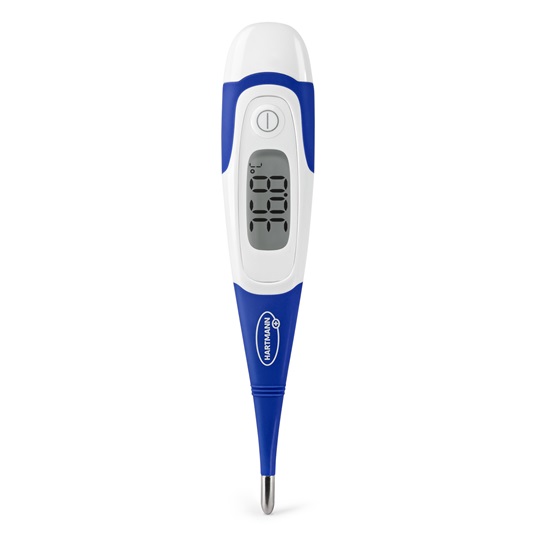
A thermometer is an essential item in many households, especially those with babies or toddlers. Different models may be suitable depending on the child’s age and the situation: digital stick thermometers are a tried-and-tested option for taking body temperature. For a quick check with as little disturbance as possible – for example, when a child is asleep – an infrared thermometer can be a practical addition. Many families use both measurement methods, depending on the situation. You can find out more about the different measurement methods and when to use them in our article “Which thermometer is right for you?”. You can find an overview of our different thermometers here.