Factsheet
Bacillol® 30 Sensitive Green Tissues
(PDF | 318.95 KB)

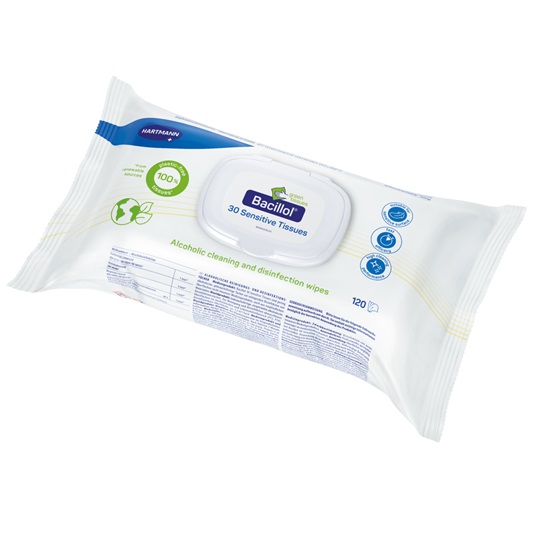
Our solution: Bacillol® 30 Sensitive Green Tissues. The new disinfectant wipes are 100% plastic-free, made entirely from renewable raw materials and have a 25% lower carbon footprint than conventional PET wipes.
Switch to Bacillol® 30 Sensitive Green Tissues and help to ensure that resources are used responsibly.
The new Bacillol® 30 Sensitive Green Tissues are just as powerful, material and skin compatible as our classic Bacillol® 30 Sensitive Tissues. We are now also saving 25% of CO2 per pack and 50% per tissue.1 We have achieved this through improved packaging design, raw materials sourced from renewable forestry, and more efficient logistics.
1Compared to Bacillol® 30 Sensitive Tissues
2The world's leading testing, inspection and certification company.
3If occupational health and safety and infection protection allow it.
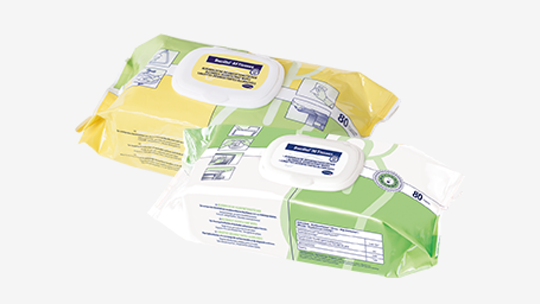
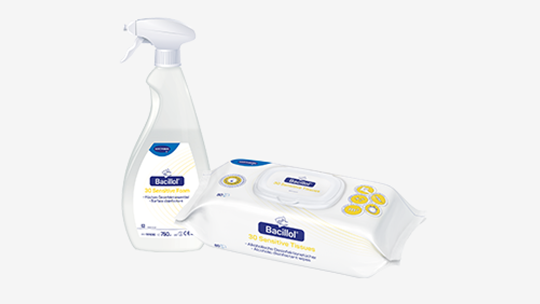
Bacillol® 30 Sensitive Tissues (blue)
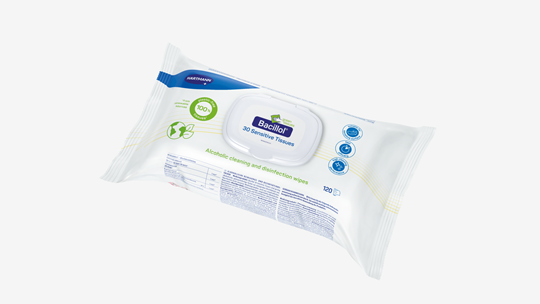
Bacillol® 30 Sensitive Green Tissues (green)


The cloth fibres provided by our suppliers and used in Bacillol® 30 Sensitive Green Tissues come from renewable forestry and contribute to preserving healthy mixed forests that promote biodiversity and protect the climate.
Not using plastic also improves the carbon footprint of Bacillol® 30 Sensitive Green Tissues. This is because, unlike normal PET wipes, significantly fewer greenhouse gases are produced during manufacture.

The absence of plastic in the wipe material used is less harmful for the environment and health. The reason: every wipe with conventional PET disinfectant wipes releases microplastics that can enter the lungs, blood and even the heart through breathing.
This is precisely what Bacillol® 30 Sensitive Green Tissues prevent, as the wipe fibres are made from renewable raw materials.

Compared to the Bacillol® 30 Sensitive Tissues, we have significantly increased the packaging content of the Green Tissues: instead of 80 wipes, each flowpack now contains 120 wipes, which corresponds to a 50% more content.
You can now clean 60m² more surface area with one pack. The increased number of wipes also means significantly less packaging waste. A 100% higher pallet utilisation also saves on transport routes.4

In 2022, over 800 million5 wipes were used for surface disinfection in Germany alone, which corresponds to 1,600 tonnes6 of plastic. The production and disposal of such quantities of PET generates 5,100 tonnes of CO₂.7 This is roughly equivalent to the CO₂ emissions of 3,400 car commuters in one year.
These figures show how many emissions the healthcare sector could save if facilities such as hospitals were to switch to completely plastic-free disinfectant wipes in the future.

Plastic has another problematic dimension: large quantities of it end up in the oceans in the form of microplastics. It is estimated that up to 10 million tonnes of plastic end up in the oceans every year.
The problem is that the particles often contain toxic pollutants that are not only harmful to marine life, but also to humans if they eat fish contaminated with microplastics, for example. This is precisely why it is so important to replace plastic with natural and renewable raw materials wherever possible.
OUR BESTSELLERS
NOW SUSTAINABLE
*Meassured by the number of wipes compared to Ballicol 30 Sensitive Tissues

On 16 January 1924, the pharmacist, chemist and scientist Dr Kurt Bode founded the Bacillol factory Dr. Bode & Co. and brought forth innovations such as Bacillol®. Since then, the further development of the products has focussed equally on the well-being of patients and the safety of users.
"We finally need a disinfectant that is more effective. Preferably alcohol-based."
"We no longer want aldehyde in disinfectants, it is no longer suitable for use in the health and food sectors."
"A convenient, quick application that fits into our stressful everyday lives - that would be nice."
"We want an all-rounder in terms of outstanding effectiveness, material compatibility and range, which can also be used without gloves."
"We want to enable healthcare facilities to achieve their environmental targets - without having to compromise on high efficacy or good skin and material compatibility."