
Wound Management
Zetuvit Plus
Learn more


| Exudate component/Characteristic | Level in non-healing wounds (incomparison with healing/acute wounds) | Comments |
| Pro-inflammatory cytokines | Higher | Cell-signalling molecules (cytokines) that stimulate the inflammatory process can increase levels of MMPs in relation to the levels of the proteins that inhibit MMP activity; in effect this increases MMP activity |
| Matrix metalloproteases*:MMP-2 and MMP-9 | 10-25 x higher | High levels of MMPs may result in degradation of growth factors; if rates of extracellular matrix (ECM) degradation match or exceed rates of ECM production, healing can be slowed or halted |
| Growth factors | Lower | Growth factors stimulate the proliferation and migration of cells involved in new blood vessel formation, epithelialisation, wound contraction and the deposition of extracellular matrix. In non-healing wounds, levels of growth factors are lower than in healing wounds, probably mainly because of degradation by proteolytic enzymes |
| Mitogenic activity** | Lower | Proliferation of fibroblasts (mitosis), a key aspect of wound healing, is stimulated to a much lower extent by fluid from non-healing wounds than by fluid from healing wounds |
Table 2: Examples of differences in wound exudate composition between non-healing and healing wounds
(Yager et al, 1996; Trengoveet al, 1999; Trengove et al, 2000; Barrientos et al, 2008; Schultz et al, 2011; Stacey, 2018)
*Matrix metalloproteases (MMPs) are released by macrophages, endothelial cells and epidermal cells and degrade proteins, including those in the extracellular matrix.
**Ability of wound exudate to stimulate fibroblast proliferation.
Wound exudate (or ‘wound fluid’ or ‘wound drainage’1) is produced as a natural part of the healing process2.
But in the wrong amount, of the wrong composition, or in the wrong place, it can be clinically challenging4,6,10,11:
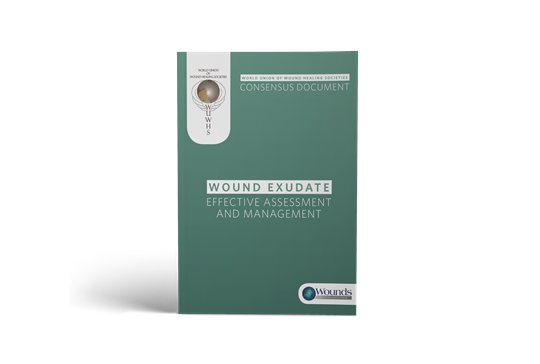
In the latest WUWHS consensus document, three key areas are mentioned specifically for effectively managing wound exudate3:
1. Optimise wound bed moisture level
2. Protect surrounding skin
3. Manage symptoms and optimise patients’ conditions
Excessive exudate:
• Often leads to leakage, soiling and odour.
• Can result in periwound skin damage and wound expansion.
• May disrupt social lives due to the need for frequent dressing changes as well as fear and embarrassment
Optimising wound bed moisture level starts with assessing the exudate amount. In the 2019 consensus document (Link2019WUWHS consensus document PDF) the WUWHS favours Falanga’s Wound Exudate Score. It has three simple classifications9:
Dressings are central to managing the moisture level of the wound bed3. For the first time, the latest WUWHS consensus document includes superabsorbent polymer (SAP) dressings as suitable for both levels 2 and 3 of Falanga’s exudate score. SAPs are highly effective, maintaining their fluid retention capacity under compression and providing high moisture vapor transmission rate (MVTR). Gaining in popularity among clinicians, SAP dressings offer clinicians a high level of versatility when treating chronic and acute wounds3. (Pop-Up Read more about the three simple classifications and dressing requirements: Table from consensus PDF, P. 16, Table 8, excerpt Falanga, Dressings are central to managing the moisture level of the wound bed3.For the first time, the latest WUWHS consensus document includes superabsorbent polymer (SAP) dressings as suitable for both levels 2 and 3 of Falanga’s exudate score.
SAP Advantages
Superabsorbent polymer (SAP) dressings can help optimise these issues: They are highly effective, maintaining their fluid retention capacity under compressionThey provide high moisture vapor transmission rate (MVTR). Gaining in popularity among clinicians, SAP dressings offer clinicians a high level of versatility when treating chronic and acute wounds3.
With excessive exudate production, the absorption andretention capacity of the wound dressing are specifically important. If the capacities are exceeded, this can have serious consequences especially for the periwound area.Excessive exudatein non-healing wounds:
Studies show that elevated levels of proteases result in a 90% chance the wound won’t heal3.
Prolonged exposure to these elevated levels of proteolytic enzymes can cause skin maceration* and erosions.
(*Hover-OverMaceration: Maceration is a softening of the skin due to prolonged exposure to moisture and proteolytic enzymes, which predisposes skin to breakdown10.)
Damagedskin is more susceptible to irritants and may become inflamed16. This can result in wound expansion and cause pain and discomfort for the patient10. One study found that 70% of patients had periwound skin conditions characterizable as dry, macerated,excoriated or inflamed17.
SAP advantages
Superabsorbent polymer (SAP) dressings can provide protection for the vulnerable periwound skin:effectively absorbing and locking in excessive exudate preventing contact with the surrounding area effectively locking in the elevated level of proteases (MMPs) in the exudateSAP dressings with a silicone contact layer further minimise skin trauma during dressing changes.

Excessive exudate can have a serious psychosocial impact on patients and reduce their quality of life11.The areas impacted includephysical, psychological and social:
- Malodour is the most distressing and socially isolating wound-related symptom, according to patients and carers12
- The need to change dressings can be physically damagingto thewound bed or periwound skin
- The needto change dressings canalso be distressing for patients. Bothintheir workandsocial lives.
- Fear of leakage or odour can lead to embarrassment
- It canevenprevent patients from leaving their homes1
68% of patients reported a negative emotionalimpact on life with symptoms such as anger, depression and social isolation18.
SAP advantages
SAP dressings can help mitigate these issues: - Their high absorption and retention capacity helps prevent leakage while providing a comfortable treatment option - They can sequester odour by absorbing and locking in proteases. Consequently, SAP dressings can help to reduce some of the stress and social isolation that patients with moderate to high exuding wounds experience. This in turn can help patients regain the confidence they need to partake in their social lives.
As an easy-to-use wound dressing or multi-stage solution, SAP wound dressings offer a versatile solution for moderate to highly exuding wounds by3:
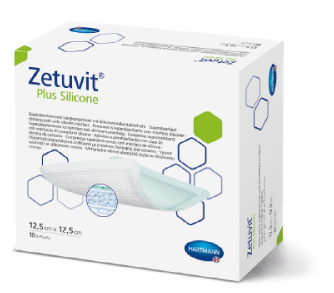
Zetuvit® Plus Silicone, the first atraumatic SAP dressing from HARTMANN – combining highly effective exudate management with simple and atraumatic wound care

1. World Union of Wound Healing Societies (2007)Principles of best practice: wound exudate and the role of dressings. A consensus document. London: MEP Ltd. Available at:www.woundsinternational.com
2. Lloyd Jones M (2014) Exudate: friend or foe?Br J Community Nurs(Suppl): S18–23
3. World Union of Wound Healing Societies (WUWHS) (2019) Consensus Document.Wound exudate: effective assessment and management.WoundsInternational.London: MEP Ltd. Available at:www.woundsinternational.com
4. Trengove N, Langton SR, Stacey MC (1996)Biochemical analysis of wound fluid from nonhealing and healing chronic leg ulcers.Wound Rep Reg 4(2): 234–9
5. White R, Cutting KF (2006)Modern exudate management: a review of wound treatments.World Wide Wounds. Available at:www.worldwidewounds.com/2006/september/White/Modern-Exudate-Mgt.html
6. Cutting KF (2003)Wound exudate: composition and functions.Br J Community Nurs 8(9 Suppl): suppl 4–9
7. Gibson D, Cullen B, Legerstee R et al (2009)MMPs Made Easy.Wounds International 2 1(1). Available at:www.woundsinternational.com
8. Moore Z, Strapp H (2015)Managing the problem of excess exudate.Br J Nurs 24(15): S12–7
9. Falanga V (2000)Classifications for wound bed preparation and stimulation of chronic wounds. Wound Rep Reg 8(5): 347–52
10. Voegeli D (2012)Moisture-associated skin damage: aetiology, prevention and treatment.Br J Nurs 21 (9): 517–21
11. Benbow M, Stevens J (2010)Exudate, infection and patient quality of life.Br J Nurs 19(20): S30–6
12. Gethin G, Grocott P, Probst S, Clarke E (2014)Current practice in the management of wound odour: an international survey.Int J Nurs Studies 51: 865–74
13. Chamanga E. Effectively managing wound exudate.Br J Community Nurs. 2015 Sep;Suppl Wound Care:S8, S10. doi: 10.12968/bjcn.2015.20.Sup9.S8.
14. Caley M et al. Metalloproteinases and Wound Healing. Adv Wound Care (New Rochelle). 2015 Apr 1; 4(4): 225–234. doi: 10.1089/wound.2014.0581
15. Dowsett C (2012) Management of wound exudate. Independent Nurse. Available at:www.independentnurse.co.uk/clinical-article/management-of-wound-exudate/63637/
16. Wounds UK (2013) Best Practice Statement. Effective exudate management. London: Wounds UK. Available at:www.wounds-uk.com
17. World Union of Wound Healing Societies (2016) Advances in wound care: the triangle of wound assessment. London: Wounds International. Available at:www.woundsinternational.com
18. Swezey L (2014) Moist wound healing. Wound Educators. Available at:https://woundeducators.com/wound-moisture-balance/
If you have any questions

... about HARTMANN, our international partners or any of our products or services – or are interested in discussing your professional healthcare needs – please don’t hesitate to get in touch.

