
Spotlight Series
From Management to Healing with Wound Balance

Read the interview with Dr. Laura Swoboda about her award winning approach “Wound Balance”.
Learn more


Patient-centred care is the focus of what we do at the Royal Adelaide Hospital. The patient is at the centre, at the core of quality improvement activities such as the evaluation of Silicone SAP dressings (SSAP). The work we have undertaken to improve the ‘wound balance’ in patients with malignant cutaneous wounds (MCWs) has been impactful for oncology patients, their families and the nursing staff who care for them.
Making a difference in patients’ lives every day is what keeps me motivated in my daily work. If I can make a positive difference and improve their wound-related symptoms, then I’ve done my job well and made someone’s life better, especially as studies show that the quality of life of patients with palliative wounds is signifi cantly impacted. That is why I became a nurse – it is so rewarding to reduce suffering and improve a patient’s wound-related symptoms to make their end-of-life (EOL) journey more comfortable. If I can do that AND lessen the workload of the bedside nursing staff by using a composite dressing such as the SSAP
dressing, it is a win-win.
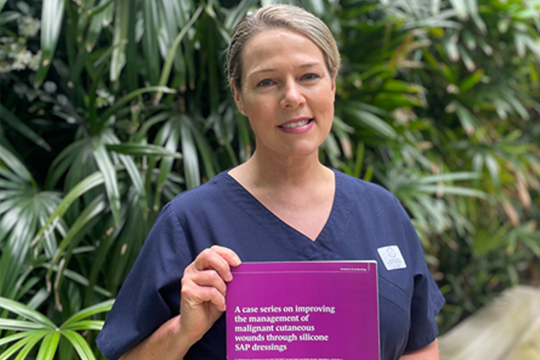

The previous standard of care involved at times up to three different dressings being used along with fixation tape. Issues occurred when an SAP dressing (without silicone) was put on and the MCW exudate level dropped (which it can), causing the dressing to stick to these painful wounds. Also, if conformability does not occur with the primary dressing product, then exudate will pool in skin folds/crevasses, causing periwound skin moisture-associated skin damage. The silicone interface of the SSAP dressingassists with conformability and periwound skin protection, while the SAP absorbs the exudate. If MCW exudate is not absorbed, it is painful and distressing to patients, especially if leakage and odour occur.
Firstly, the results of this publication have influenced my approach to the care of patients with MCWs through heightened consideration for atraumatic application and removal using a Silicone SAP dressings (SSAP). Secondly, as MCWs can be highly exuding but can also reduce their output, the silicone on SSAPs prevents the dressing from sticking, meaning they are less likely to cause trauma/pain, are easier to change/remove and can absorb various degrees of exudate. Thirdly, the SSAP dressing results have helped us to streamline a Quick Guide to MCW Dressing Algorithm which has been drafted, has undergone an internal expert review and will eventually be an appendix to our wound management procedure for MCWs.
Recently, we had a younger couple where the husband was caring for the wife through her EOL cancer journey. With the introduction of SSAP dressings to our organisation, we were able to give them a dressing regimen which included he SSAP dressing along with the use of a super-oxidised hypochlorous antimicrobial solution spray to cleanse the wound, which simplified the dressing process, lengthened the time between dressing changes and reduced wound dressing procedural pain. It is through such innovations that we improve a patient’s quality of life in the final days of end-of-life care.
Case vignette
78-year-old female with a large ulcerative right cheek lesion – moderately differentiated squamous cell carcinoma.
Proactive factors addressed
Atraumatic application and removal helped greatly to reduce local pain. Exudate was contained within the dressing, and the wound was covered satisfactorily. “People no longer stare at the wound as I have a dressing in place,” the patient said, “which is soft and comfortable.”
This demonstrates that with the appropriate choice of dressings it is possible to make a difference to patients' quality of life in malignant cancerous wound care, even where wound healing is no longer the primary goal.
