

An unwelcome visitor to the patient: blood infection

Asepsis breach: a daily risk
A patient’s struggle
Clara and her husband felt helpless. The outcome can be deadly: CLABSI is associated with mortality rates of 15-25% worldwide3. Additionally, secondary manifestations of Central Line Associated Bloodstream Infection (CLABSI) can develop, such as cardiac valve infection (endocarditis) or bone infection (osteomyelitis).
In Clara’s case, her infection was not so severe, but still it was very stressful and impacted her recovery.
“The doctors began a course of antibiotics immediately, but I had to stay two days longer in the hospital and was sick an additional ten days after I returned home. It was a very exhausting time.”


The risk of an infection with venous peripheral catheterization should never be underestimated. The consequences are simply too harmful – and sometimes deadly.
A nurse’s challenge

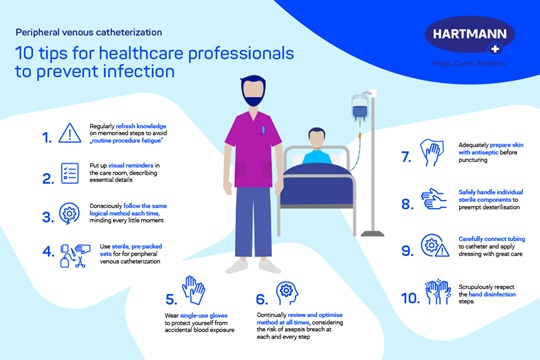
Visual aids help remind staff of the steps to follow in order to reduce the spread of infection. Easy to read and easy to share!
Download the infographic "10 tips for healthcare professionals"
Preventing CLABSI in vascular access procedures
There are many circumstances which make fighting infection a daily struggle. However, it doesn’t have to be an uphill battle. Infection is preventable! There are scientifically established procedures that are proven to reduce CLABSI rates by up to 70%4.
Medical care centers and hospitals can support staff by adopting outcome-oriented solutions. These combine sterile, easy-to-use, pre-packed Infusion MediSets® with training and digital aids to support a high level of adherence to aseptic techniques and standardized protocols.
Let us work together with you to tailor solutions to your medical establishment, bringing your tactics for infection prevention to a new level of effectiveness and safety.
Learn more about the 5 MediSets® for peripheral venous catheterization.

Sources
1European Center for Disease Prevention and Control, Healthcare-associated infections – a threat to patient safety in Europe, ECDC, 2018.
2Suetens et al. Prevalence of healthcare-associated infections, estimated incidence and composite antimicrobial resistance index in acute care hospitals and long-term care facilities: results from two European point prevalence surveys, 2016 to 2017. Euro Surveill. 2018.
3https://eu.bd.com/iv-news/scientific-publications/managing-and-preventing-vascular-catheter-infections-a-position-paper-of-the-international-society-for-infectious-diseases/
4Zingg et al. (2014) Hospital-Wide Multidisciplinary, Multimodal Intervention Programme to Reduce Central Venous Catheter-Associated Bloodstream Infection. PLoS ONE 9(4): e93898.